Tuesday, 31 May 2011

Malaysia Design Technology Centre (MDTC), Cyber Jaya, Malaysia

MDTC is Malaysia’s national design and technology hub, and comprises of the International Design Museum and exhibition spaces, professional design offices, and the HQ for the ‘Limkokwing Institute of Creative Technology’ campus.

The prominent hill-top location above the new technology town of Cyberjaya reflects MDTC’s status for innovative technologies and creative design.


The distinctive design of the MDTC is its expansive features, such as the ‘wing-like’ canopy roof that extends over the International Design Museum. This huge canopy functions as an ‘umbrella’, elevated over the central plaza for environmental shelter of large scale social events – such as concerts, exhibitions and public arena – enhanced by natural cross-ventilation breezes that cool the expansive plaza below.

The canopy roof protects the International Design Museum and a major exhibition space, and is framed by viewing ‘gallery decks’ that wrap around the plaza in a continuous ramp – from the plaza level to the underside of the design museum.


Extensive rooftop landscaped terraces insulate the building from the hot tropical sun. Lush green foliage enhances natural cooling of commercial and education blocks. The Limkokwing Institute of Creative Technology is an innovative and friendly campus. Teaching areas enjoy atrium spaces for natural lighting and ventilation. The campus has become a ‘design dynamo’ for the MDTC.

We designed the MDTC as ‘socially permeable buildings’ that encourage social interaction and activity for people who work, study, live or visit the Centre. The central block embodies the objective of the MDTC to project a vibrant image in ‘design related activities’ with elegant commercial studios and inspiring facilities to students. Project designed by Ken Yeang prior to joining Llewelyn Davies Yeang.

Monday, 30 May 2011

A good material for the manufacture of kitchen - Modern Home Minimalist

luxury kitchen sets concept design furniture
Kitchen Sets Design

luxury kitchen sets concept design furniture
Kitchen Sets Design

luxury kitchen sets concept design furniture
Kitchen Sets Design

luxury kitchen sets concept design furniture
Kitchen Sets Design

luxury kitchen sets concept design furniture
Kitchen Sets Design

Coloring Of The Kitchen Sets - Modern Home Minimalist

coloring kitchen sets designColors in the kitchen, we sometimes confused to decide. In fact, in the case of a dye, that is, everyone has different tastes, but if the color you like can be adapted to the design of your kitchen. The dye is part of the finish are in need of inspiration for a kitchen that can produce stunning and beautiful.

Some pictures of the kitchen which is a source of inspiration for you to determine the color of the kitchen.

coloring kitchen sets design

Small Sofa: Marcel Mini Sofa - Minimalist Decorating Idea

Small sofa furniture design appropriate for your minimalist home interior design.


The ultimate spot for reading and relaxing, this small sofa has a thick cushion and a padded back with tapered arms for supreme comfort.
  • 55" wide x 28" deep x 34" high
  • Single-padded seat cushions; extra-thick foam core.
  • Kiln-dried hardwood frame.
  • Care varies depending on fabric type.
  • This is a special-order item and ships directly from the manufacturer. To view our order and return policy, click on the Shipping Info tab above.
  • Watch a video about the high quality of our upholstered furniture.
  • Crafted in the USA. Via: potterybarn

Minimalist House Design of Colman Triplex by Workshop for Architecture | Design

The Colman Triplex is a minimalist house design located in Seattle. This house was design by Workshop for Architecture | Design collaborated Christiane Pein and LairDesign as interior designer. This house has views of downtown Seattle across a park that lies both to the east and north. To allow each dwelling to inhabit a specific portion of the site, the sloping topography was reshaped into two distinct levels. The Colman Trilpex designed direct access to landscape and exterior space with exploration of the exterior cladding screen. Visit Workshop for Architecture | Design website or read architects description after the images.


From The Architects
…Within a primary box-like form the design team responded to budget and strict land use limitations on building height and lot coverage to configure three separate dwellings that each provides direct and visual access to landscape and exterior space. The frame is secondary to the spatial organization and connections of each dwelling and is therefore concealed within the non-load bearing walls.Through operations of subtraction, larger scale spatial relationships are made between interior and exterior spaces. These operations create both apertures, openings that provide daylight and visual connections between inside and out, and porches, or habitable covered exterior space. A broad horizontal array of windows connects the upper dwelling’s main living space to the sky and distant view. A private interior light-well brings daylight and a private landscape into the master bathroom. Entry porches, similar to the historical fabric of neighborhood, both buffer and connect the adjacent park to the open living spaces….

Sunday, 29 May 2011

Hongkong and Shanghai Bank Building

The building was designed by the British architect Norman Foster. From the concept to completion, it took 6 years (1979-1985). The building is 180-metres high with 47 storeys and four basement levels. The building has a module design consisting of five steel modules prefabricated in the UK by Scott-Lithgow Shipbuilders near Glasgow, and shipped to Hong Kong. 30,000 tonnes of steel and 4,500 tonnes of aluminium were used. It was an urban legend that the building’s modular design enables it to be dismantled and moved, if there was any possibility of a disrupted handover to the People’s Republic of China.
The main characteristic of HSBC Hong Kong headquarters is its absence of internal supporting structure. Another notable feature is that natural sunlight is the major source of lighting inside the building. There is a bank of giant mirrors at the top of the atrium, which can reflect natural sunlight into the atrium and hence down into the plaza. Through the use of natural sunlight, this design helps to conserve energy. Additionally, sun shades are provided on the external facades to block direct sunlight going into the building and to reduce heat gain. Instead of fresh water, sea water is used as coolant for the air-conditioning system.

All flooring is made from lightweight movable panels, under which you can find a comprehensive network of power, telecommunication, and air-conditioning systems. Hence installation of equipment or computer terminals becomes far easier.

The requirement to build in excess of one million square feet in a short timescale suggested a high degree of prefabrication, including factory-finished modules, while the need to build downwards and upwards simultaneously led to the adoption of a suspension structure, with pairs of steel masts arranged in three bays. As a result, the building form is articulated in a stepped profile of three individual towers, respectively twenty-nine, thirty-six and forty-four storeys high, which create floors of varying width and depth and allow for garden terraces. The mast structure allowed another radical move, pushing the service cores to the perimeter so as to create deep-plan floors around a ten-storey atrium. A mirrored sunscoop reflects sunlight down through the atrium to the floor of a public plaza below a sheltered space that at weekends has become a lively picnic spot. From the plaza, escalators rise up to the main banking hall, which with its glass underbelly was conceived as a shop window for banking.


The bridges that span between the masts define double-height reception areas that break down the scale of the building both visually and socially. A unique system of movement through the building combines high-speed lifts to the reception spaces with escalators beyond, reflecting village-like clusters of office floors. From the outset, the Bank placed a high priority on flexibility. Interestingly, over the years, it has been able to reconfigure office layouts with ease, even incorporating a large dealers room into one floor – a move that could not have been anticipated when the building was designed.

Saturday, 28 May 2011

Panama House-Art House Design in Sao Paulo by Marcio Kogan

Panama House is an Modern, Luxury and elegance art house located in Sao Paulo Brazil by Marcio Kogan. In the past, the Panama House designed with no cozy nooks, no soft furnishings, and no homey touches. And yet, there is a feeling of comfort and livability in this art-gallery-of-a-house that makes you want to move in tomorrow. All levels of the three-storey house — including the bedrooms, office, gardens and patio — are used to display the owner’s substantial collection of predominantly modern Brazilian art and sculpture. An uninterrupted connection between inside and out makes the entire space seem unlimited, translucent, as if without walls, although the structure is essentially a wooden box inside a C-shaped concrete cask made of cement slabs and a wall.
The sliding vertical wood lathes that form the brise soleils for each room’s facade, are also an important part of establishing the prevailing openness. The brise soleils also provide comfort and privacy, and enable the control of the artworks’ exposure to direct sun. Most beautifully, they also create the soft play of light that matches the overall linear shapes — created by creases in window treatments, the floor boards, the rows of pillows on long sofas, the stone work outside — continuing the elongated language of the entire building.


Friday, 27 May 2011

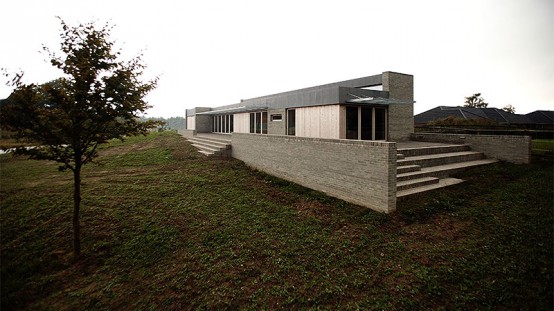
A Single-Family House Overlooking Fields and Fyn Beech Forest Read more: http://www.digsdigs.com/a-single-family-house-overlooking-fields-and-fyn-bee

This beautiful single-family house is located on a hill overlooking fields and Fyn beech forest. Its consists of two composite boxes which are done in simple gray, custom-made stone. The side facing the fields and forest, characterized by large windows that invite natural light inside. On the other side windows in contrary are made very small and low in order not to spoil the view with neighbors houses. The interior floors are mostly dones in specially polished oak which are made of small glued pieces. It doesn’t consist of standard rooms but has an open plan which is deviled by sliding doors and curtains. Thanks to that its interior is always different because chaining it is a very very simple task.

[Jeppe Utzon]A